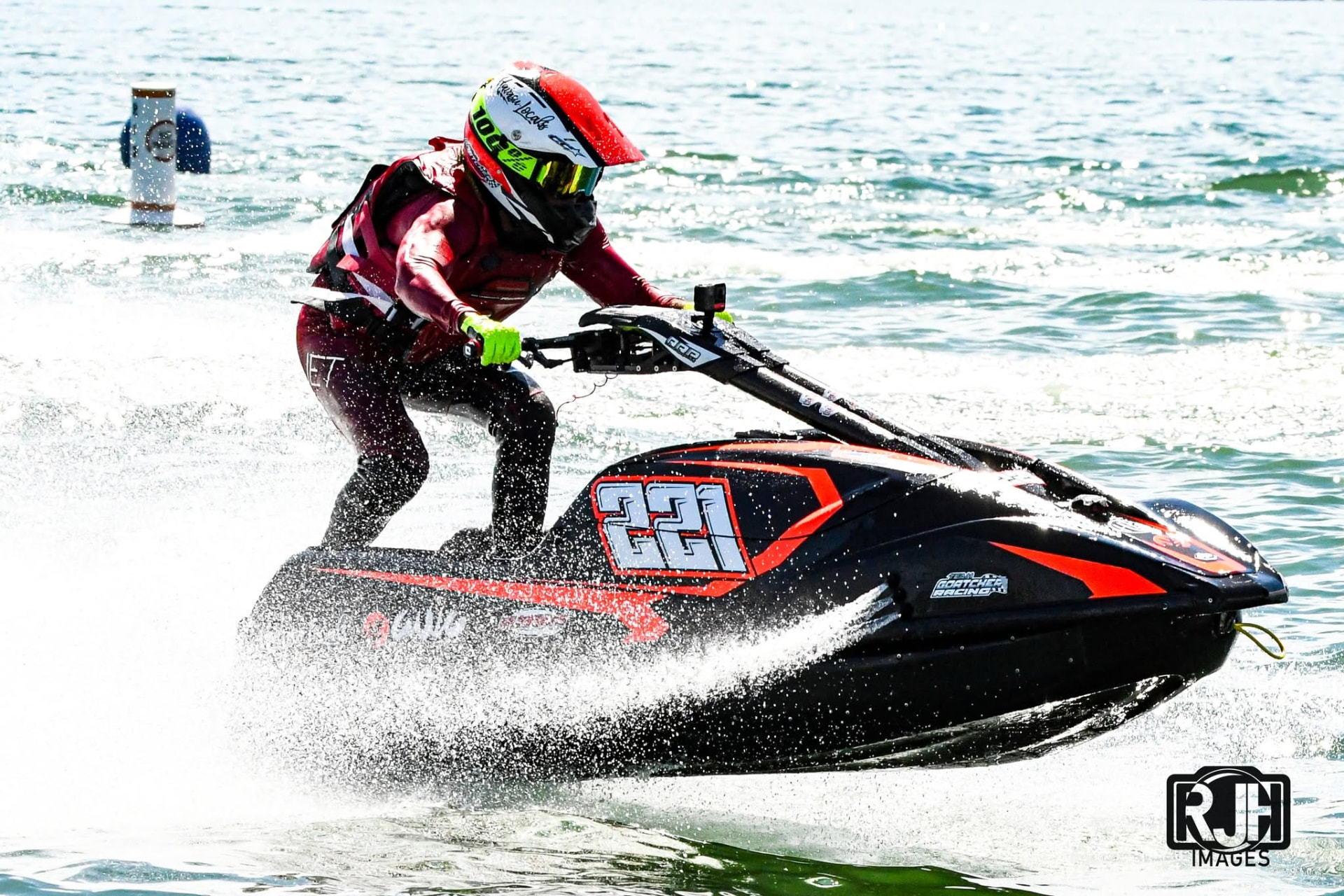
Closed-course jet ski racing is one of the most exciting — and most welcoming — motorsports around. You don't need a pro budget or a lifetime of experience to start. This guide walks you through every step, from your first visit to the pits to crossing the checkered buoys. Fees, dates and rules change each season, so always confirm details with the series before you go. Compiled November 2026.
The tutorial
6 steps to your first race
- 01
Watch a race and walk the pits
Spectating is the best first step. Admission to the 2026 IJSBA World Finals in Lake Havasu City was free — walk the pits, ask questions and watch how a race weekend runs.
- 02
Try a practice or test-and-tune day
Wild West Watercross runs a Friday “First time racer Test & Tune” session, and East Coast Watercross offers optional Friday practice. It's a low-pressure way to ride the course.
- 03
Join a club or team
A team gives you a pit to share, tools, advice and people who have done it before. Team Goatcher Racing helps newcomers get started.
- 04
Choose a starter class
Stock and Novice classes are aimed at modest cost. Before buying a ski, confirm it's legal for the class with the series' chief inspector.
- 05
Find a mentor
Experienced racers and officials are generous with advice. Ask about setup, starts and course rules before your first moto.
- 06
Get your membership, register and race
Buy your IJSBA (or IHRA) membership, register early to avoid late fees, pass tech and line up for your first start.
Step one
Memberships & licenses
IJSBA competition membership
- The main US sanctioning body — it also runs the World Finals in Lake Havasu City.
- Required at US races using IJSBA-provided insurance.
- Listed at $85 new / $80 renewal (verify yearly). Promoters may add a $10 endorsement.
- Skill levels: Junior, Novice, Expert, Pro (Ski); Novice, Expert, Pro (Runabout/Sport).
- Buy online or on site at Wild West, Best of the West and PNW WaterX.
- Non-US riders: your country's IJSBA affiliate license is valid at the World Finals.
IHRA watercraft membership
- The International Hot Rod Association also sanctions watercraft racing.
- Covers all IHRA-sanctioned watercraft events; expires December 31.
- Includes a jersey. Types: Racer, Crew, Associate — all insured at IHRA events.
- Single-event memberships may be available from the organizer.
Which do I need? IJSBA for Wild West Watercross, Best of the West, PNW WaterX, East Coast Watercross, Pro Watercross and the World Finals. IHRA for the IHRA Pro Watercraft Series.
Step two
Choosing a class
Ski is stand-up, Runabout is sit-down, and Sport classes like Sport Spec have their own spec rules.
Stock classes are intended “at a baseline level… with relatively modest investment and maintenance costs.” Limited, Superstock, Modified and GP allow progressively more modifications — an Expert or Pro license is recommended for GP.
Stock examples (Wild West 2026): Ski Stock — Kawasaki SX-R 1500 or Yamaha 4-stroke SuperJet; Ski 4-Stroke Lites — Yamaha SuperJet 2021+; Runabout 1100 Stock / Rec Lites — up to 1100cc naturally aspirated 4-stroke; Sport Spec — 720cc or 701/760cc twin 2-stroke.
Age and category groups include Junior lap challenges (8–13), Junior 10–12 and 13–15, Women's, Veterans 35+, Masters and Grand Masters. Brand new? Look for Novice or Sportsman (no racer history) classes.
Where to race
Jet ski race series
Pro Watercross — Liqui Moly National Tour
“The Road to Havasu.” 6–8 national stops; each racer's top 4 scores count, with the finale in Lake Havasu City. Select classes aired on CBS Sports in 2026. Register at register.livemotorsports.com/prowatercross.
Visit siteWild West Watercross (IJSBA Region 2)
Northern California and Nevada. Four motos per round combined into one overall score. Ski, Runabout, Sport, Vintage and Junior classes. Registration through MotoTally.
Visit siteHydro-Turf Best of the West Series
Run by RPM Racing Enterprises across Parker, Huntington Beach, Mission Bay and Lake Havasu. Race two events to qualify for the IJSBA World Finals. No money required to pre-register; $25 per class late fee after the deadline.
Visit siteNauti Water Racing — Lake Havasu Series
Windsor Beach, Lake Havasu State Park. Shares combined points with Best of the West — a great home-water starting point. Also runs the Outlaw and Mid-America series.
Visit sitePNW WaterX
IJSBA-sanctioned Pacific Northwest championship. Register in the RacersEdge app; pay online or cash at check-in; check in by 8:00 AM. IJSBA memberships available on site.
Visit siteIHRA Pro Watercraft Racing Series
National tour launched in 2026 with a minimum $250,000 prize pool. Uses IHRA membership (Racer, Crew or Associate), valid for the calendar year.
Visit siteEast Coast Watercross
East region series registering through the Pro Watercross system. IJSBA membership required to race or practice.
Visit siteIJSBA World Finals
The biggest stage in the sport, held every October in Lake Havasu City. Classes run from Junior Lap Challenges and Sportsman (no racer history) up to Pro Ski GP.
Visit siteSee where Team Goatcher is racing next on our race calendar.
Budget
What it costs
| IJSBA membership | $85 new / $80 renewal |
|---|---|
| Entry fee — 1st class (ECW 2026) | $240 |
| Entry fee — 2nd class (ECW 2026) | $200 |
| Late fee | $25 (per class at Best of the West) |
| Transponder rental (ECW) | $40 per weekend |
| Optional Friday practice (ECW) | $40 |
| Camping | $40–$50 per night |
| Team Goatcher planning figure | $225 per class per race |
2026 examples — verify current fees with each series. Add fuel, travel, lodging and gear.
Safety first
Required safety gear
Helmet
Full-face, required for practice and racing. Approved: Snell M2010/M2015, DOT FMVSS 218, ECE 22-05 or JIS T 8133:2007. No bolt-on chin guards, bicycle or BMX helmets. Approved color or reflective tape.
Life vest (PFD)
USCG-approved Type I or III full jacket, worn at all times on the water. Inflatables not allowed.
Back protector
Required for Ski (stand-up) classes. Must spread impact, not absorb water, about 45 mm max thickness.
Goggles
Shatterproof eye protection — highly recommended and on the tech checklist.
Footwear
Closed-toe shoes or boots are on the tech checklist.
Gloves & wetsuit
Standard kit for most racers for grip, warmth and protection.
Your lanyard kill switch must work — taping or wiring it is prohibited. Juniors follow the same gear rules. No cast, splint or brace without written approval from a doctor and the Race Director.
Before you ride
Passing tech inspection
You must pass tech before any practice or racing. Based on the IJSBA safety checklist:
- PFD buckles properly, DOT full-face helmet, eye protection, closed-toe shoes
- Hull clean, dry and drained — no cracks, illegal skegs, fins or rudders
- Bumpers in good condition and a flexible bow tow loop; protruding tow hooks removed
- Race numbers in a contrasting color, at least 7 inches tall
- Handlepole, steering, throttle and grips secure; lanyard stop switch working
- Clamps secure, battery strapped, fuel system tight, USCG flame arresters, no leaks
- Stock-type classes: sound limit 86 dB(A) at 75 ft; bypass outlets point down
What to expect
A typical race weekend
Friday
- Pits open
- Check-in and registration
- Safety inspection (tech)
- Test and tune
Saturday
- Sign-in and tech
- Mandatory riders' meeting (~8:00 AM)
- Practice by class group
- Moto 1, lunch, Moto 2
Sunday
- Riders' meeting
- Last-chance practice
- Motos 3 and 4
- Awards (after the protest period)
Scoring: four motos combine into one round score, and rounds build the series standings.
On the water
Starts, buoys & flags
The start
- Be in staging while the race before yours runs — miss the halfway point and you can lose your spot.
- Holders: Ski 1 holder + 1 mechanic; Junior Ski 10–12, Runabout, Sport and X2 get 2 holders.
- Shore start lights: red engines off, yellow start your engine, green go.
- Ski riders keep both feet down before the start and must be standing before the first turn buoy.
- One 2-minute hold allowed while the “2” card shows. A jumped start costs one lap.
Buoys
- Yellow — turn right. Red/orange — turn left. Checkered — start/finish.
- Missed a buoy? Take the penalty buoy on the same lap or get a 1-lap penalty. Never circle back.
- Missing a finish-line buoy is an automatic 2-position penalty.
- After a fall, wave a hand overhead with a thumbs up to show you're OK.
Flags
- Green
- Race on
- Yellow
- Hazard on course
- Red
- Stop and return to the start
- Black
- Leave the course and report to the Race Director
- Blue w/ yellow diagonal
- You're being lapped
- Crossed checkered & white
- Halfway point
- White
- One lap to go
- Checkered
- Finish
- Red with checkered
- Race ended early due to a hazard
Pack the trailer
First-race checklist
- Tech-ready ski with race numbers
- Trailer and ski cart
- Tool kit and spares: plugs, lanyard, clamps, zip ties, battery
- Fuel in marked containers (metal containment tray where required)
- Dry-chemical fire extinguisher in your pit
- Helmet, vest, back protector, goggles, gloves, boots, wetsuit
- Canopy with weights where stakes are banned
- Water, food, sunscreen, shade and chairs
- IJSBA card (or money to buy one), registration confirmation, ID
First-event tips
- Register early — late fees apply.
- Arrive Friday if you can.
- Never miss the riders' meeting — it's mandatory.
- Know your heat order and be in staging early.
- Take your fuel cans home; some series penalize leftover containers.
Questions
Frequently asked
Do I need a license to race a jet ski?
Usually yes — an IJSBA competition membership for most US series. IHRA events use an IHRA membership.
How much does it cost to start?
IJSBA membership is about $80–$85 a year. Entry fees vary by series — for example, East Coast Watercross 2026 charged $240 for your first class and $200 for the second. Add fuel, lodging and gear. Team Goatcher plans around $225 per class per race.
How old do you have to be?
Junior classes run 10–12 and 13–15, and the 2026 World Finals offered Junior 8–13 Lap Challenges. Open classes are generally 16+ — check current IJSBA rules.
Can I race my recreational ski?
Possibly, if it fits a class such as Rec Lites or a stock class and passes tech. Ask the series' tech inspector first.
What's the difference between Ski and Runabout?
Ski is stand-up; Runabout is sit-down. Sport classes such as Sport Spec have their own spec rules.
What is a moto?
One race. Most western series run four motos per weekend, combined into one round score.
Can I buy a membership at the race?
Yes, at many series including Wild West Watercross, Best of the West and PNW WaterX.
Do I have to race the full season?
No. Single rounds are fine.
Where should I start in Lake Havasu?
The Lake Havasu Series at Windsor Beach, which shares points with Best of the West.
Speak the language
Jet ski racing glossary
- IJSBA
- International Jet Sports Boating Association, the main sanctioning body
- IHRA
- International Hot Rod Association; runs a pro watercraft series
- Closed course
- A buoyed course raced in laps
- Moto
- One race
- Round
- One race weekend
- Ski
- A stand-up jet ski
- Runabout
- A sit-down watercraft
- Stock → GP
- Stock, Limited, Superstock, Modified, GP: modification levels from least to most
- Lites
- Smaller-displacement ski classes
- Tech
- The pre-ride safety and rules inspection
- Lanyard
- The kill-switch tether that stops the engine
- Holder
- The person holding the ski at the start
- Staging
- The waiting area before your race
- Pole position
- The start spot closest to the first turn buoy
- Shore start
- A dead-engine start from a stop on a light signal
- Rolling start
- A start behind a pace boat
- Penalty buoy
- The make-up buoy after missing one
- Transponder
- The timing and scoring device on the ski
- Sponson
- A hull-side fin that affects handling
- Restrictor plate
- A power limiter used in some junior classes
Ready to race? Together we win.
Team Goatcher Racing is based in Lake Havasu City, Arizona, and helps newcomers get started. Meet the TGR Riders, read the latest news, or reach out — we'd love to see you at the start line.
Talk to the team